

Living with bladder problems
If you experience bladder/urinary problems there is a chance that your health and quality of life will be significantly impacted. In order to clarify the cause of your symptoms and to rule out anything potentially serious, it is important to consult a healthcare professional.
Introduction to bladder problems
Bladder problems typically take the form of urinary incontinence (leaking urine) and urinary retention (inability to empty the bladder) and can arise from neurogenic conditions such as spinal cord injury, multiple sclerosis and spina bifida. Incontinence and retention can also be age related, or result from an underlying physical disease, caused by a dysfunction in the bladder. Learn how the bladder works.
Urinary incontinence
There are different types of urinary incontinence, each with different symptoms and causes. The most common types of urinary incontinence are stress urinary incontinence (SUI), urge urinary incontinence and mixed urinary incontinence.
Stress urinary incontinence (SUI) occurs when the muscles in the pelvic floor, under sudden, increased pressure (stress), are too weak to hold the urethral sphincters closed. The result is an involuntary leakage of urine during everyday activities such as sneezing, coughing, laughing or exercising.
Urge urinary incontinence (unstable or overactive bladder) is caused by involuntary, uncontrolled contractions of the muscle in the bladder. This results in a sudden urge to go to the toilet, and involuntary urine leakage before reaching the toilet.
Mixed urinary incontinence is a combination of stress urinary incontinence and urge urinary incontinence.
Overflow incontinence (a frequent or constant dribble of urine) results from an inability to empty the bladder and occurs in people with a damaged bladder, blocked urethra or neurological damage. With overflow incontinence you may feel as if you never completely empty your bladder. When you try to urinate, you may produce only a weak stream of urine.
Urinary retention
Urinary retention can be caused by an obstruction in the urinary tract, a bladder muscle weakness or by a neurogenic conditions such as multiple sclerosis, spinal cord injury or spina bifida all of which interfere with signals between the brain and the bladder, resulting in a dysfunction in the urinary system.
Urinary tract infections
When your bladder is not emptying properly there is a risk that the residual urine in the bladder will become infected. This could cause further complications (for example urinary tract infections) if it is not removed regularly. It is important to seek help if you experience symptoms of urinary retention.
How the bladder works
Urine is produced in the kidneys, and flows from the kidneys into the bladder via the ureters. The bladder stores urine until the urethra carries it out of the body. This flow, from the bladder to the urethra, is controlled by the urethral sphincters, which open and close the bladder outlet. The sphincters, in turn, are controlled by the pelvic floor muscles. The healthy bladder expels urine in a controlled, usually voluntary fashion, and the average person urinates 4-8 times a day.
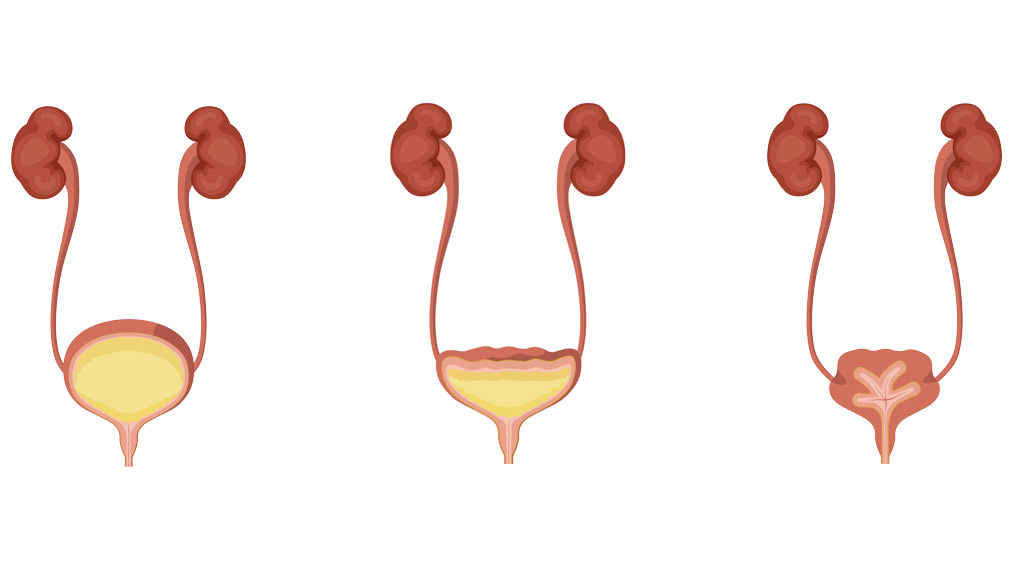
Bladder activity is regulated by the central and peripheral nervous systems. You feel the need to urinate when the stretch receptors in the bladder tell the brain that the bladder is full. However, with bladder dysfunction, you may not be able to inhibit the urge to pass urine. Problems with the bladder may result in urinary incontinence or urine retention.
Urinary incontinence
Urinary incontinence is the involuntary leakage of urine. There are different types of urinary incontinence, each with different symptoms and causes.
Urinary retention
Urinary retention can be caused by an obstruction in the urinary tract, a bladder muscle weakness or by a neurogenic condition e.g. multiple sclerosis, spinal cord injury or spina bifida all of which interfere with signals between the brain and the bladder, resulting in a dysfunction in the urinary system.
Neurogenic bladder
Neurological conditions can cause damage to the nervous system affecting the bladder and resulting in urinary retention (see above) or an overactive bladder which has symptoms of both urge incontinence and leakage.

How can Coloplast Care make a difference for you?
- Reliable advice, whenever you need it
- Supplement the education and advice you get from your stoma care nurse
- Guidance on selecting the right products
- Easy access to samples of relevant products
- Free home visits by Coloplast Stoma Care nurses
Life with an ostomy isn't always straightforward. So why go it alone?